Saturday, July 2, 2016

Creating Playful Environments

Chapter 3
Creating Playful Environments

If You Build It, They Will Play

We often set up our classrooms for us. We careful choose our color schemes or themes. We place everything in the perfect location in the room. We have everything completely organized. Then, BAM! Within the first hour, everything has changed. Our carefully thought out classroom has been changed. Our students move things. They do what works for them. We like to think our classroom space belongs to our students, but in reality most of the time we create it for what works best for us. This section will talk about changing the classroom for our students, but that doesn’t mean we can’t have an influence. (Wink, wink)

Space: The First Frontier

Space in our classrooms is always a hot commodity. Us teachers are hoarders. We don’t want to give up any of that furniture, because let’s face it. Once it’s gone, IT’S GONE! Trust me, I’ve been there. I’ve given up a table or bookshelf to another teacher and then needed it later on. But you know what, I survived. I made things work. Plus, if I had it in my room, it would have taken up space and made things more cluttered. Take the time and go through your room and really consider what you really need.

These are some things to consider when planning out your room:
-Leave Open Spaces for Children’s Creations
-The authors’ suggest to provide a space where children can leave their structures out for up to multiple days. I don’t know about you, but my room is often used by the aftercare children. This will be especially hard to do since they will more than likely touch the structures.  
-Use Furniture Flexibly
-Provide Different Kinds of Spaces Within the Classroom
-Ask Children How They Would Like to Use the Space in the Room
-The authors’ reference one teacher allowed her Second Grade students to design the classroom for learning. On the first day of school, she had here students help set up the classroom.

Extreme Makeover: Classroom Edition
Here are some questions that the authors’ want you to think about when setting up your classroom:
-Do you have flexible seating options (standing, sitting, laying) and the items to support it?
-Can you repurpose furniture (e.g., make tables shorter or taller, replace a regular table with a sand table with cover) to vary the work space in the room?
-Do you have at least one largeish space where children can build and leave their buildings standing?
-Do you have at least one smallish, cozy spot for children to recenter and feel safe?
-Do you have a space in the classroom that allows for big movement?
-Do you have materials easily available for children?
-Do you have a permanent open space to store works in progress?
-Is this environment pleasing to the eye?

Materials for Powerful Play

When organizing your classroom, keep in mind that you will need the following items for the classroom. The authors’ suggest these items for play, as well as using them in the classroom as manipulatives. Here are some suggested items plus some that I have added:
-blocks
-large, hollow blocks for building large structures
-Cardboard: boxes, rolls, cones, flat pieces
-Fabric
-Paper
-Paints
-Markers, crayons, colored pencils
-Scissors
-Tape
-Staplers
-Shells
-Rocks
-Buttons
-Pom poms
-Pipe Cleaners
-Tissue Paper
-Mini Shaped Erasers
-Foam Pieces
-Beans
-Beads
-Familiar objects from home/parents’ workplaces

Setting the Stage for Community and Caring: Building a Play-Friendly Emotional Environment

Create a Culture of Caring

The first thing that we need to do in order to create a classroom for play is establish a community. We need to set the following principles in our classroom to do so.
-Get to know each other. We need to provide opportunities to interact with each other. What better way than the first week of school? Allow your students to share their feelings, passions and ideas.
-Learn to solve problems by talking through them. Provide your students with opportunities and role play situations with them.
-Talk about self-control. What does it mean? What does it look like?
-Have class meetings to gather to share, reflect, and problem solve. Discuss situations together as a group.

Make Rules That Work

We need to establish rules that work in our classroom. Rules need to be in children’s language. Below are 3 principles to follow:

Rules Are Positive Statements
Rules Are Guidelines
Rules Mean Specific Action

Teaching with Independence in Mind: The Workshop Structure

Just like we teach writing, reading, and math in a workshop manner, we need to consider teaching “play” in this manner as well. Many of our students come into us with different levels of play. Some have only played organized games and sports, while others have played on iPads and other electronics. We also can’t assume that they can all play on the same maturity levels. By having a workshop, it will allow us to assist them in learning social skills and learning habits.

What Does Play Look Like in a Workshop Structure?

There are 2 different types of play workshops.

Choice Time Workshop
Choice Time occurs in the classroom. During Choice Time children choose to play with a variety of materials. Choice Time Workshop looks very familiar to a typical reading, writing, and math workshop. You choose a theme (1-2 minutes), have a focus lesson (3-5 minutes), plan (1-3 minutes), work or play time (30-35 minutes), and share (3-5 minutes). When modeling “choice time”, it will give your students an idea of how they should act and play during that time.

Recess

Many schools have a scheduled recess time into their day. By offering a recess workshop, it will allow those students unfamiliar with recess the opportunity to learn from the other students. A recess workshop is similar, but only has 3 parts: focus lesson (3-5 minutes), work or play time (20 minutes), and share (3-5 minutes).

*During work or play time for both workshops, the teacher is observing and offers tips to the students.

What are some ideas you have from this chapter?

Don’t forget to join me on my book study on play by reading Purposeful Play. Find it  HERE. 


Monday, June 27, 2016

Balanced Play


Chapter 2
Balanced Play: How It Makes Kids’ Lives Better

What Is Play?

Play is different for every age group. For an adult, play my be building or making something, like Joann from “Fixer Upper” decorates the houses her and her husband fix up. While for others, it may be participating in marathons. For children, play maybe taking all the pots and pans out of the cabinet like my daughter did when she was younger. While it may be play for her, it wasn’t so much for mommy and daddy. LOL! The challenge is defining play. Play can be almost anything as long as it fulfills certain characteristics. The authors of Play for a Change define play as, “what children and young people do when they follow their own ideas, in their own way and for their own reasons” (2008, 10).

Why Is Play Valuable?

Play is not limited to just humans. Go to a zoo or watch animals on a TV show and you will see them using things in their surroundings for play. I remember watching a gorilla at Animal Kingdom with my daughter playing with her food bucket. She would roll it around, place it on her head, and play peekaboo with us watching her. This was her form of play. Another gorilla in the area was picking leaves off of a tree and making things with them. This was their form of play. Play benefits us in many ways by shaping our brain. It helps us to be flexible, resilient, and allows us the ability to deal with complex situations. It allows helps develop stress-response. Think of children building a block tower together. They are working hard putting the pieces in the right spot. Their brain is learning to take risks. If they place a block in a certain place, will the tower fall over? Sometimes it does and they have to start all over. Or another students places a block in a different spot than they wanted it to be place? This is helping them with resilience and building their ability to adapt. As you can see, play is very valuable in helping children develop their minds. Children need to be able to play. We need to provide them with balanced play just as we do with balanced literacy.

Kinds of Play

There are many different kinds of play to be incorporated into balanced play for children. They are fantasy play, constructive play, games with rules, and rough-and-tumble play. Each one helps to enhance a child’s development.

Fantasy/Imaginative Play

Fantasy play is when children choose an imaginary scenario in which they act out roles and determine a set of rules for the roles. This is usually done when children play store. They assign different roles: cashier, shopper, stock person, etc. Each person has their own role and they determine the rules for each role. The stock person or cashier isn’t going to be the one buying the items. The same could be said for my students who loved to play kitchen during inside recess time. Several of them would be the cooks, while others would be the waiters/waitresses and customers. They would create menus and even write down orders on paper before serving the customers. Sometimes if they didn’t have an item they wanted, they would substitute another item for it. For example, one of my students used a block as a phone for taking take-out orders. This helped her develop her abstract thinking.

Constructive Play

Constructive play is an organized form of play that is goal/product oriented. Children use materials to create something. Most constructive play uses materials like blocks, playdough, art materials, and recycled materials. Children can use these materials in a variety of ways to meet standards. For instance, children can use the materials to make murals or costumes for characters to retell a story. By using straws, paper, beads, and other materials, children can create something,  examining,  exploring, sorting, and arranging the materials. This taps into the STEM/STEAM mindset. By incorporating this type of play, we are allowing them to problem solve, connect, deepen their understanding, an replicate their learning while keeping math, science, and engineering in the classroom.

Games with Rules

Games with rules helps children build important social skills such as cooperation. Think of your students playing hide and seek. Now think of them playing hide and seek, where the seeker isn’t covering their eyes. What would happen? For certain type of play, there are rules that need to be followed in order for the game to work. By allowing for this type of play, they are learning to  communicate   and develop healthy competition. They are understanding what it means to win and how it feels to lose. This is an essential part of building empathy. This type of play also helps them to develop their growth mindset by teaching them to learn and grow in a risk free environment for failure.

Rough-and-Tumble Play

Rough-and-tumble play is often known as play fighting or horseplay. We most commonly see this type of play on the playground. We see it in the form of running and chasing each other, playing tag, wrestling, and having sword fights. We often discourage this type of play because we often think that they will take it to far. This type of play is often controversial, but it is yet very critical to the development of children. Roughhousing is necessary to help social and  cognitive   development as well as physical development. According to Stuart Brown (2010), a “lack of experience with rough-and-tumble play hampers the normal give-and-take necessary for social mastery, and has been linked to poor control of violent impulses later in life” (89). When children engage in play fighting, they learn what it means to take it too far and build the rationale that their friends won’t want to play with them anymore. We do have to monitor this as teachers to help them determine when they have taken it too far at times.

Stages of Play

When children are playing, there are different stages in which children fall into based on their development of play. There are six stages of play:
-Unoccupied Behavior: Children will randomly observe anything that catches their interest. If nothing catches their interest, they will often fidget, spin in circles, or bang hands of table. This is the most immature form of play.
-Onlooker Behavior: This child chooses to observe others at play and will often ask them questions about their play but doesn’t play herself.
-Solitary Play: This child chooses to play alone. The child might play near another group, but will not join them.
-Parallel Play: This child will choose to play with the same materials alongside another child, but will create or build their own thing.
-Associative Play: Children who choose to play together in a group using the same materials or even play the same activity. For example, children may be playing with the blocks, but each one if building their own building to make a city.
-Cooperative Play: Children plan how they will play. They discuss and  negotiate   their roles. This is the most mature form of play.

3 Take Aways
1.    Each form of play has its benefits.
2.   During play, children are learning to create, innovate, explore, and develop.
3.   Rough-and-tumble play shouldn’t be discouraged and it is essential for them to build the rationale of “taking things too far”.
What are your 3 take aways?


Don’t forget to join me on my  book study on play by  reading    Purposeful Play.  Find it  HERE. 


Friday, June 24, 2016

Play Isn't A Luxury. It's A Necessity.

Sorry, this post is a little late. I am currently on vacation in the mountains in Tennessee and our internet is spotty. We’ll be moving on from here tomorrow, so I will be on track.  Any who, I can’t express how excited I am about this book study. I can’t wait to get into it more and hear all of your thoughts.

Chapter 1
Play Isn’t A Luxury. It’s A Necessity.

This chapter starts off in a kindergarten classroom where there are children playing in different areas. There are children playing with Magna Tiles building, others playing in the kitchen area, and others making a haunted house with blocks. The teacher is observing her students playing together. Two girls in the kitchen area were having an argument over who would play mommy, since both children wanted to be mommy and another student stated that they both could be mommies. After observing for some time, the teacher determined that this was a teachable moment and that she needed to discuss the differences in families and what families are. 

Why Choose Play? Answers to Common Questions About the Role of Play

We Follow the Common Core State Standards. How Does Play Fit with Meeting the Many Standards?

The Standards are our endpoint. They are what we need to accomplish with our students by the end of the year. How we choose to get there is not dictated. There is no set map. The authors state that play allows for multiple opportunities and modes to reach the various standards. For instance, a standard in Speaking and Listening states that children need to follow agreed-upon rules for conversations. By implementing play into our classrooms, students have the opportunity to engage in discussions with peers and develop problem solving skills while playing. This can be demonstrated by their communication in building structures with blocks and even cooking in the kitchen. Another standard that can be  integrated   is the standard for reading fiction that states that a student should retell texts with key details. Children often during play will re-enact their favorite stories or even stories that were just read.  

How Can There Be Time for Play When There Is Such an Emphasis on Academic Rigor?

First off, the authors define what academic rigor means. According to Barbara Blackburn, author of Rigor Is Not a Four-Letter Word, “Rigor is creating an environment in which each student is expected to learn at high levels, each students is supported so he or she can learn at high levels, and each student demonstrates learning at high levels” (2013, 13). The authors believe that play is one type of environment where children can be rigorous in their learning. Play is a natural environment for children which allows them to feel free to take risks. They will often use their imagination to explore their creativity and become flexible thinkers and build their communication skills.

But What About My Students Who Need Extra Support? Wouldn’t Their Time Be Better Spent Engaged in Small-Group Instruction?

In this section the authors discuss the importance of small group instruction. Yes, small group instruction is important, however, play should not be replaced by it. Some students who have difficulty in certain areas can benefit from play because it gives them access to content and higher level thinking in a variety of modes. Play gives them opportunities to express their thinking through multiple sign systems. Sign systems are the different ways of communication and can be done through art, music, drama, and language. (Short, Harste, and Burke, 1996). Children can also engage in choice time, which is another type of play. This gives them the opportunity to build with blocks, paint, and dramatic play. Choice time allows students to tap into their own strengths and gives them access to learning at higher levels.

How Much Time In the Day Do Children Really Need to Play? Can’t Children Just Play When They Are Finished with Their Work?

In the beginning, we often struggle to develop our students’ stamina in reading and writing. However, when our same students are playing either during recess or choice time we can often see the stamina last for a longer amount of time. With this, we need to look at play from a different point of view. Play is the work of children. While playing, our students are developing ideas, creating, discovering, taking on and assigning roles, collaborating, developing and negotiating rules, and being active listeners with each other. If play is there work, then how can we incorporate it across the curriculum.

After reading this chapter, it has gotten my brain into motion on how play is beneficial to all learners.

3 Take Aways
1.    Students need play everyday to build on their strengths and develop key communication and social skills.
2.   Play is natural for them.
3.   Play can be incorporated into daily lessons to achieve goals.

What are your thoughts about this Chapter? My mind is in motion on how to put play back into my classroom. I can’t wait to share with you all and get your ideas.


Don’t forget to join me on my  book study on play by  reading  Purposeful Play.  Find it  HERE. 


Sunday, June 19, 2016

I'm Bringing Play Back Book Study

For years now, I have been wanting to bring back play into my Kindergarten classroom.  We have been told over and over again to take it out of our daily routine. I  know it isn't my administrators fault. It comes from the higher ups. I would occasionally break that rule and allow my students the time to play. I know, I know, I'm a rebel. (Smack the back of my hand.)  But guess what? My students  still succeeded and were able to get a little time to develop the necessary developmental skills they  need. I have been searching for that research based text to help me show those who question me  the proof they need.  Well, I HAVE FINALLY FOUND IT! Woohoo!!!!!!!! (Sorry, for so many exclamations. I am to excited.)

Join me on my  book study on play by  reading  Purposeful Play.  Find it  HERE. I know many of you may be busy with travel plans, but you can always come back and follow along when you can. 

Below are a list of  the dates in which you can come back and  share your thoughts and comments. I can't wait for you to join me. 


Saturday, April 9, 2016

Where have I been?

Wow! It's been awhile since I have blogged.  This year, I have been  stressed out. I needed to take a step back and do more for myself as well as my family.  See this year, my daughter started Kindergarten.  Well, being a Kindergarten teacher and having a Kindergartner at home really takes a toll on you. LOL! I am surrounded by Kindergarten 24/7. Eeeekk!!! Yup! That's my life! I'm not going to lie. At times, it did take a toll on me, but you know what? I wouldn't change it for anything. I LOVE my kiddos! I LOVE my little girl! I LOVE ALL the Kindergarten CRAZINESS!

Well, over the past few months I have fault guilty. You know that guilt.  The Teacher Mom Guilt! 

I came across this blog post  on "Keeping Up With Mrs. Harris" and it spoke to me. 

It got me thinking about all the sacrifices my daughter faces with me being a teacher, as well as, my husband being a teacher.

Meals-  My daughter eats breakfast, lunch, and snacks at school. Due to the fact that I have to be at work so early each morning, she has to eat breakfast in the car or in my classroom each morning. I felt guilty for not being able to give her that time  each morning that  a normal child sits down at the table and eats their breakfast.  I felt guilty.  This  needed to change. I make it a point to  sit down with her each morning and eat breakfast at my teacher table . It has now become routine and kind of a mommy-daughter date.

Long Hours at School-  You know we  all spend those long hours at school. We never feel like we have everything done. I was the same way.  Majority of her day is at school.  I  felt bad. Many days she just wanted to be home and playing with her toys. I made the decision that no matter what I needed to leave at a decent time. Whatever  wasn't done by that time would have to wait until the next day.  

School Work at Home- This was a BIGGIE for me! I always, ALWAYS brought things home to work on. I would come home, cook dinner, and right after dinner start working on things for my classroom, TPT store, or even my blog. This had to change. I wasn't giving her my attention.  Now we come home,  we read together, play together, and she  plays while I cook dinner. It's our time together. I make sure that  I don't touch any thing for school until after she goes to bed and I have had a little down time for myself.

Overall, I needed to take this time to be with my family.  I needed the time to figure out  how to balance everything. Yes, I LOVE my students. I didn't want to take away from making learning fun for them,  but I was overworking myself and it was taking a toll on my family.  I needed to be there for my family. I needed to  step back and figure it all out. I have! I'm back and I'm ready to get back into things again. I can't wait to share more with you all.

Leave some love and let me know how you balance everything in your teacher life.

Sunday, October 4, 2015

Scarecrows Galore

This year I have a lot of students who are struggling with  their fine motor skills. I have  many who can't hold a pencil or scissors correctly.  I have been working with them a lot. Some have picked up very quickly, while others still need more practice. 

To practice our fine motor skills, I have found that doing crafts has helped them a lot. I find that having them trace the patterns onto the construction paper instead of already having the patterns on the paper helps them a lot. They have to hold down the tracer while tracing around the pattern.  After tracing the patterns, they cut out the pieces and start putting them together.  We have been doing this with crafts based on the topics we are learning about. This past week, we have been learning  about Fall. I created an adorable scarecrow craftivity that we created. The first one is my example.
For the patches, I cut out different sized squares of scrapbook paper. I chose patterns that were fall or  country pattern. Here are my students scarecrows.
(Notice  the one with the pink shirt and purple pants. My student wanted it  to look like it was walking. So creative!)


You can definitely see my students different abilities. Many of them have come a long way. I absolutely LOVE how these turned out. They are ALL precious in their own way. 

Check out my Scarecrow Craftivity to  add some fall into your room. I would love to see  your students creations.


Sunday, August 9, 2015

Ziggedy- What is it?

Have you heard of Ziggedy?  I hadn't until just recently.  It's a new  site to help teachers earn money for their classrooms.  How does it work? Well,  it's just like ebates,  where  you get free cash from the online shopping that your parents, family, and friends do.  There is no cost for the the funds and the funds go directly to you to use in your classroom as you see fit.

Ziggedy has partnered with many popular retailers, such as, Target, Walmart,  Amazon, Home Depot,  Best Buy, Groupon,  and so many more.  

How does it work?

Once you have created an account, you will have access to custom templates to send out to your parents, family, and friends. There are  flyers, emails, and even social media templates that can be used.  After setting up your account and sending out the information, you will be able to see your supporters who have signed up in your Piggedy Bank.  

After they sign up , they sign onto the Ziggedy site and follow the links to make purchases. When they make their purchase, you will receive a certain percentage back to your account. You can see how much each supporter has earned for your classroom.

You will receive a check for your classroom at the end of each quarter (January,  April, July, and October). Then, you can take the money and use it towards your classroom needs.  Who doesn't LOVE free money? Click on the Ziggedy Banner below to get started.

Monday, June 29, 2015

Kindergarten Prep Activities

At the end of each year,  my school gives a Kindergarten Readiness Test to our incoming students. After the test, I am often asked by the parents about what they can work on with their child over the summer.  As a kindergarten teacher, I know that I will receive a wide range of students with varying skill levels.  The test just gives me a snapshot of what they know coming into kindergarten. I try to stress to them  to not stress about what their child doesn't know and to trust me that they will learn it. 

This year is a little different for me, as my own daughter will be entering Kindergarten.  I know that all to soon,  she will be entering a classroom which may or may not have a lot of exploration time. I want her to work on the skills that I know she will need when she enters her classroom, but I want her to do it in a fun way.

The transition into kindergarten  is a major milestone for  the child and their family. Many of them will be going to a school where they may or may not have nap time. They will be eating lunch in a cafeteria with many other students from different grade levels, which they are not accustom to.  Here are some things that you can do over the summer to make the transition easier.

-Wash their hands. (Kindergarten kids are very germy and this is a big one.)
-Snap, button, zip, and buckle. (Shhhhh...my secret to avoid the buckle part  is to cut off the belt loops. Trust me! I have had several students tighten their belts way to tight while trying to get  it undone. I thought  I would have to cut the belt entirely to get it off.)
-Tie their own shoes. (This is a BIG one. Many kindergarten teachers won't tie shoes, so start practicing now. If they do, they will stop after Winter Break.)
-Put on and take off a jacket.
-Open and close containers in lunchbox , as well as, open and close their lunchbox on their own. (Many times they are eating in the cafeteria and while their are aides in there for assistance, they may be busy.)
-Can use bathroom without assistance.
-Ask for help when needed.
-Listens and follows simple directions.
-Respects personal space.  
-Plays well with others and takes turns.
-Know their first and last name.
-Write their first name.
-Say their ABC's.
-Count  from 0-10. 
-Knows colors.
-Knows shapes.
-Holds pencil appropriately.
-Holds and cuts with scissors properly. (Surprisingly there are many students who can not do this.  This is very important in building their fine motor skills. One simple way to practice scissor skills is  getting a plastic tub  and  place strips of tissue paper or paper inside.  Allow them to cut up the strips into small pieces into the bin. The best scissors to use are the child scissors with the blunt tip. I recommend the Fiskars brand.)
-Cutting on a line. (Simply draw lines across a paper and have your child cut on the line.)
-Play with play doh. (This will also help with fine motor skills and build their muscles. Have them  roll it to make letters. Another fun one is to  tell them a number and have them roll balls of play doh to show that number. When they get it right, they get to smash the play doh balls.)
-Let them play outside. Have them run, jump, skip, and just play. (You will be surprised by how many of my students don't know how to play tag or hide and go seek outside. I know that if I give them an iPad , they will be able to tell me everything  about it and even show me new things. However, they don't know how to play on a playground or with other students at recess.)

Besides they simple things, I have also included a FREEBIE that  you can use for some fun  review  for kindergarten. Click on image to grab it. Enjoy!


Thursday, June 18, 2015

Teaching With Intention Book Study: Chapter 3

Hi,  everyone! You will all have to bare with me as I am writing this post while on vacation.  (I am currently in the mountains of Tennessee and  haven't had to much access to the internet or even pictures of my classroom. I literally ended school , packed up, and left on vacation.  Really it was a much needed break!) Anywho,  I wasn't able to blog about the first 2 chapters, but am linking up with the 3rd chapter. 

This chapter  is all about the classroom environment from the book Teaching With Intention. This book study is brought to us by Kindergarten Smorgasboard. Thanks, Greg!

I'm linking up with this week's hosts: Surfin ' Through Second, The Learning Chambers, and Sassy, Savvy, Simple Teaching.

The first thing that is discussed in the book is about a new teacher who is overwhelmed in her classroom with  stuff that has been left there for her. Who hear has ever felt that way?  I know I sure did my first year of teaching. I was just like Katy. I took over a classroom from a teacher who retired and left everything for me.  Some of the things were great and some of the things were so old. I'm talking  about the purple ink ditto machine copies. Who remembers those? Yup, I was so overwhelmed! I ended up  getting help from other teachers and tossing so much.  Well after reading this chapter, it began to dawn on me that I'm starting to see the same thing happen to me again. Yup, I have become that teacher! You know the one who saves things because of the "what if I need it someday" mentality. Raise your hand if that is you? Come on, I know you are out there. Well, ya'll!  It's time for me to  "Clear the decks!"  I will be  going into my classroom and taking charge like a pirate. I will be "swabbing" my classroom clean.  I'm going into my 10th year of teaching. I have taught Kindergarten through 3rd grade. I have been carting around  things that I haven't used in years. I need to get rid of those things.  What better time than now! Especially, since I am moving rooms.

The next  thing that Debbie Miller wants us to think about is...

I have been thinking about this a lot during the last few weeks. Yes, I know summer has just started but I can't turn off my teacher brain. My  husband who is also a teacher says I'm driving him crazy. LOL! Oh well! 

In my classroom, I need a classroom meeting area, library,  cubbies, small group area,  word wall,  and data wall (that is  mandatory school wide).  Here are a few pictures from my classroom this past year.  Remember, I don't have access to many right now. 


This year, I want to have 2 meeting areas. One will be  in front of my Calendar Math and Morning Meeting Board with my easel, while the other will be in front of my Interactive Board. This one will be new to me and I'm not sure if I will have enough room. I'm going to try  my best to make it fit. I will also me moving my small group area to a different part of my room.  My classroom library needs to be revamped and easier for my students to access and put materials away better.  There is so much to think about. My brain is on overload. 


Next up,  is how will I set up my tables. Yes, I have tables in my Kindergarten classroom. I have 4 circle tables and 3  rectangular   tables. I have been racking my brain on where I will be placing them.  With the new meeting area, I'm not sure yet where the tables will fit. I want them to be in an area where they can easily see the board  yet be together to work with each other.  I am also toying around with the idea of having personal work mats for with they are at their learning stations and /or working independently. I love Greg's use of the bath mats. Check it out here!


Organization is key in any classroom. This is definitely one of my downfalls. There are so many ways for teachers to have their students keep their items.  I have  community supplies on each table.  I just simply replace the items that are running low into their tubs. I also have a little scrap bin for them to place their paper scraps in instead of getting up and throwing things away repeatedly while working.  I have areas for all of my students items, but I need to organize myself better. I am one of THOSE people who has everything ready for a lesson and then BAM! Something is missing! It was right there a minute ago and now I am looking around everywhere for it.  This even goes for those papers needed by admin or even ESE. Yup, I'm one of those. I have been scouring Pinterest looking for ideas on getting myself better organized. Any suggestions, please share!  I would love to hear everyone's thoughts on these topics. 


Monday, March 2, 2015

March Currently

I can’t believe it is already March!  Man, February flew by! It's that time again for a new Currently. I love doing these and  getting to know others. 

Listening: "The Big Bang Theory" I love this show. 

Loving: This whole week, we will be celebrating Dr. Seuss. I can't wait to show off the  shirt I made for tomorrow. I'm going as "The Cat In The Hat". 

Thinking: I have SO much to do on my list and I keep adding more things.

Wanting: Yup, I want a change. I'm not sure exactly what kind of change, but I need a change.

Needing: I have paperwork that I was handed today right before I left for an IEP. Don't you hate getting things right before you leave and they state that they need it back tomorrow.

Spring Break Plans: We're going to Disney World!  Our daughter doesn't know it yet as we are surprising her. We only live 3 hours away so we go quite often. I can't wait ! We leave on the 20th.

Check out all the other Currently's at Farley's site. Click below to head on over.


Saturday, February 28, 2015

Shape Pizzas

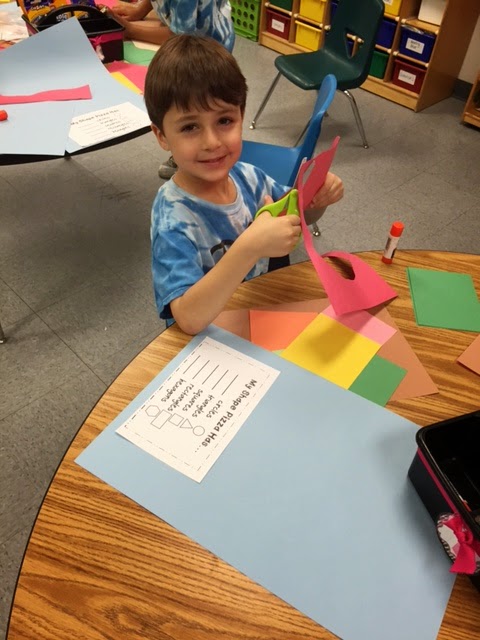
This week , we worked on two dimensional shapes. Each year , I usually do an activity with food and sorting the food by shapes. I would use corn chips, cookies, Cheez Its, Cinnamon Toast Crunch,  etc. This year with so many food allergies, I had to get creative. So , we made shape pizzas. We used construction paper to make our pizzas. Each student was given  paper for the dough, sauce, and then 5 different colors for the shapes. Our curriculum only has them learn 5 shapes for Kindergarten.  I do cover more, but this is what is required for them to know. The shapes are circle, triangle, square, rectangle, and hexagon. I gave each student their materials, modeled it for them, and then let the little chefs begin.


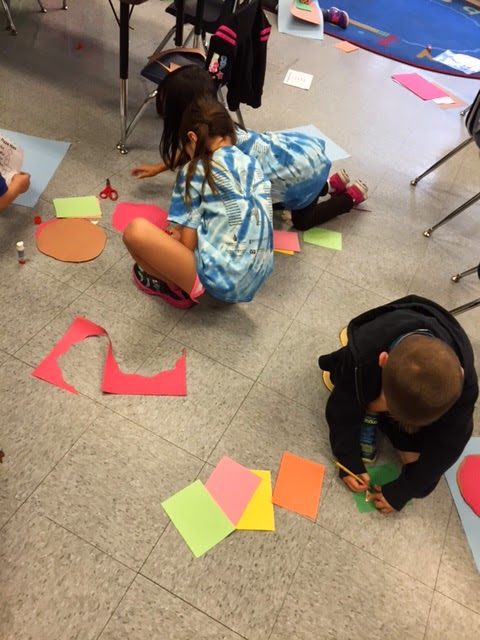
Some stayed at their seats to work, while others wanted to spread out and work on the floor. 


They had a lot of fun making their creations. There were so many variations . Here are a few:


They had  also had to write how many of each shape they made and what color they used for the shape at the bottom. I love them! Share with us what fun activities you do with shapes. I can't wait !